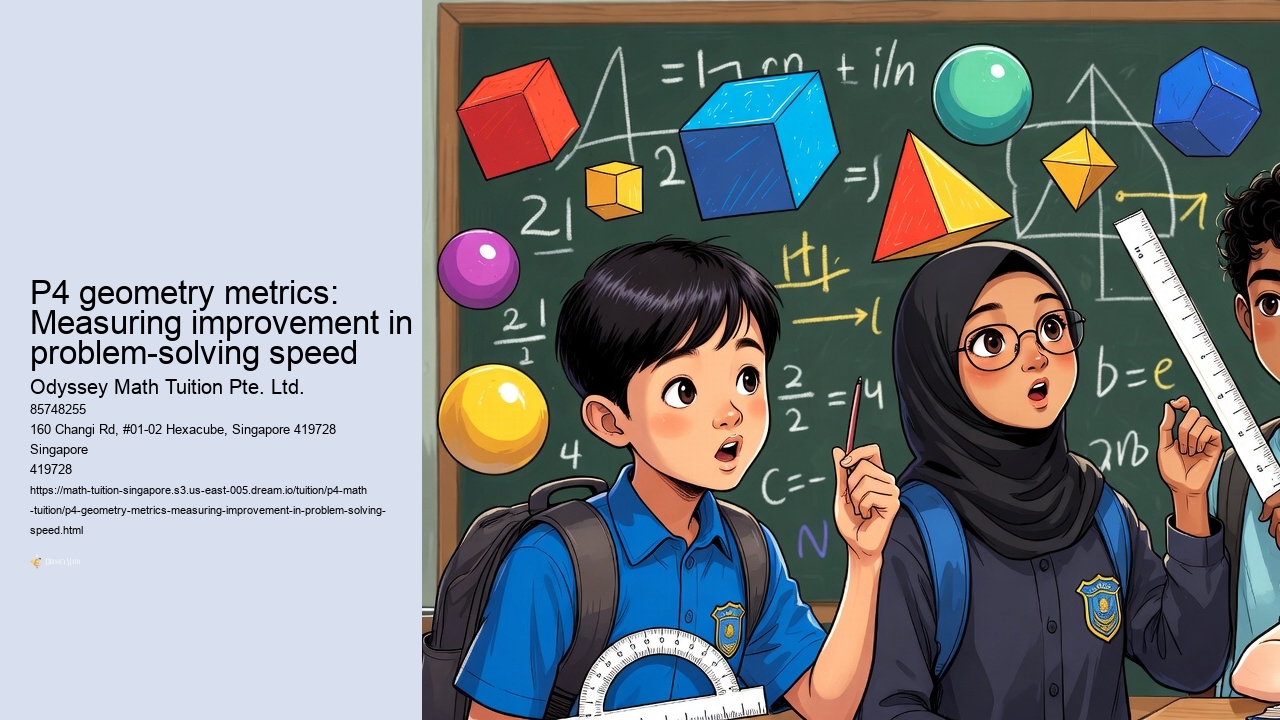
P4 geometry metrics: Tracking progress in shape recognition skills
Is Your Child Geometry-Ready for P4 Math?
Are you starting to feel the "kiasu" creeping in as your child enters Primary 4? Don't worry, you're not alone! P4 is a pivotal year in the Singapore education system, a stepping stone towards the PSLE and beyond. In today's competitive educational landscape, many parents in Singapore are seeking effective methods to enhance their children's comprehension of mathematical principles, from basic arithmetic to advanced problem-solving. Building a strong foundation early on can significantly elevate confidence and academic performance, helping students conquer school exams and real-world applications with ease. For those investigating options like p4 math tuition it's vital to prioritize on programs that highlight personalized learning and experienced guidance. This strategy not only resolves individual weaknesses but also cultivates a love for the subject, leading to long-term success in STEM-related fields and beyond.. It's when the math concepts get a little more "leh chey" (complicated), and geometry is definitely one of those areas. A solid grasp of geometry now isn't just about acing those P4 math exams; it's about setting your child up for success in secondary school, JC, and even their future career. Think about it – strong math skills open doors to engineering, data science, finance, and even medicine!
And in this age of AI? Forget about it! Math is the language of computers. Geometry, in particular, helps build the spatial reasoning skills that are essential for understanding AI, machine learning, and data analysis. So, making sure your child has a strong foundation in geometry is like giving them a head start in the future. If you're thinking, "aiyo, where got time to teach myself and then teach my child?", don't fret! That's where P4 math tuition comes in. It's about getting targeted support to help your child not just cope, but truly excel.
P4 Math Geometry Fundamentals
Okay, let's break down what exactly your child will be facing in P4 geometry. The Singapore MOE syllabus focuses on building a strong understanding of shapes, angles, and spatial reasoning. It's not just about memorizing formulas; it's about understanding why those formulas work and how to apply them to solve problems.
Key Concepts Your Child Will Encounter:
Lines and Angles: Identifying different types of lines (parallel, perpendicular, intersecting) and angles (acute, obtuse, right, reflex). They'll be learning how to measure angles using a protractor and understanding the relationships between angles. This is crucial because many geometric problems build upon these fundamental concepts.
2D Shapes: Deepening their understanding of shapes like squares, rectangles, triangles, circles, and other polygons. They'll be learning about the properties of these shapes, such as the number of sides, angles, and lines of symmetry.
Area and Perimeter: Calculating the area and perimeter of squares, rectangles, and triangles. This involves applying formulas and understanding the units of measurement. This is where things start to get a bit more challenging, as students need to visualize the shapes and apply the correct formulas.
Symmetry: Identifying lines of symmetry in 2D shapes. This helps develop spatial reasoning skills and the ability to recognize patterns.
Geometric Problem Solving: Applying their knowledge of lines, angles, shapes, area, and perimeter to solve word problems. This is where math problem-solving skills become really important.
Why These Fundamentals Matter:
These geometry fundamentals are not just isolated topics. They form the building blocks for more advanced math concepts in upper primary and beyond. A weak foundation in geometry can lead to struggles in topics like volume, surface area, and even algebra later on. More importantly, these skills are crucial for developing critical thinking and problem-solving abilities, which are essential for success in any field.
Fun Fact: Did you know that the concept of area was first developed by the ancient Egyptians to measure land after the annual flooding of the Nile River?
Tracking Progress in Shape Recognition Skills
So, how do you know if your child is keeping up with the P4 geometry curriculum? It's not just about looking at their test scores. You need to actively track their progress and identify any areas where they might be struggling.
Here's how you can do it:
Regular Review of Homework: Take a look at your child's geometry homework and see if they are consistently getting the answers correct. Pay attention to the types of mistakes they are making. In this nation's challenging education structure, parents play a crucial part in directing their kids through key tests that influence academic paths, from the Primary School Leaving Examination (PSLE) which tests fundamental competencies in subjects like math and scientific studies, to the GCE O-Level exams emphasizing on intermediate mastery in multiple disciplines. As students move forward, the GCE A-Level assessments demand deeper critical skills and subject proficiency, frequently determining higher education entries and occupational trajectories. To keep knowledgeable on all aspects of these national exams, parents should explore authorized information on sec 1 exams papers offered by the Singapore Examinations and Assessment Board (SEAB). This ensures entry to the latest curricula, examination timetables, registration information, and instructions that match with Ministry of Education requirements. Consistently consulting SEAB can aid families prepare efficiently, reduce ambiguities, and bolster their offspring in attaining optimal outcomes amid the challenging scene.. Are they struggling with specific concepts or are they making careless errors?
Practice Worksheets and Quizzes: Supplement their schoolwork with extra practice worksheets and quizzes. This will help reinforce their understanding of the concepts and identify any gaps in their knowledge. You can find plenty of free resources online, or you can purchase workbooks specifically designed for P4 math.
Active Questioning: Instead of just giving them the answers, ask them questions about the concepts. This will help you gauge their understanding and identify any areas where they need more explanation. For example, you could ask them, "Why is this shape a rectangle?" or "How did you calculate the area of this triangle?"
Observe Their Problem-Solving Process: Watch how your child approaches geometry problems. Are they able to break down the problem into smaller steps? Are they using the correct formulas and strategies? Are they able to explain their reasoning?
In the rigorous world of Singapore's education system, parents are ever more intent on arming their children with the competencies required to thrive in rigorous math syllabi, encompassing PSLE, O-Level, and A-Level studies. Recognizing early signals of challenge in subjects like algebra, geometry, or calculus can create a world of difference in fostering resilience and mastery over intricate problem-solving. Exploring trustworthy singapore maths tuition options can offer tailored guidance that corresponds with the national syllabus, guaranteeing students obtain the edge they require for top exam scores. By focusing on interactive sessions and steady practice, families can assist their kids not only satisfy but exceed academic expectations, paving the way for future opportunities in high-stakes fields..
Seek Teacher Feedback: Talk to your child's math teacher and ask for their feedback on your child's progress in geometry. The teacher can provide valuable insights and identify any areas where your child might need extra support.
Recognizing Warning Signs:
Be on the lookout for these warning signs that your child might be struggling with geometry:
Consistently low scores on geometry quizzes and tests.
Difficulty understanding the basic concepts of lines, angles, and shapes.
Struggling to apply formulas to calculate area and perimeter.
Avoiding geometry problems or expressing frustration when faced with them.
Difficulty visualizing shapes and spatial relationships.
If you notice any of these warning signs, don't panic! It's important to address the issue early on. Consider seeking P4 math tuition to provide your child with the targeted support they need to catch up and build a strong foundation in geometry.
Interesting Fact: Geometry, as a formal system of mathematics, can be traced back to ancient Greece, with Euclid's "Elements" being one of the most influential textbooks in history!
The Role of P4 Math Tuition in Geometry Mastery
Let's be real, sometimes school lessons alone aren't enough. The classroom environment can be fast-paced, and your child might not get the individual attention they need to truly grasp the concepts. That's where P4 math tuition comes in. It's not just about getting extra help; it's about providing your child with a personalized learning experience that caters to their specific needs and learning style.
How P4 Math Tuition Can Help:
Targeted Support: A good P4 math tutor can identify your child's specific weaknesses in geometry and provide targeted support to address those areas. They can break down complex concepts into smaller, more manageable steps and provide plenty of practice opportunities.
Personalized Learning: Unlike a classroom setting, P4 math tuition allows for a more personalized learning experience. The tutor can tailor their teaching methods to your child's learning style and pace. They can also provide individualized feedback and encouragement.
Increased Confidence: When your child starts to see progress in their geometry skills, their confidence will soar. This can have a positive impact on their overall attitude towards math and their academic performance in general.
Exam Preparation: P4 math tuition can also help your child prepare for exams. The tutor can provide practice questions, review key concepts, and teach effective test-taking strategies. This can help your child feel more prepared and confident on exam day.
Developing Math Problem-Solving Skills: A key focus of good P4 math tuition is to impart math problem-solving skills. This includes teaching heuristics, model drawing, and other strategies that can help your child tackle challenging geometry problems.
Choosing the Right P4 Math Tuition:
When choosing P4 math tuition, it's important to consider the following factors:
Tutor's Experience and Qualifications: Look for a tutor who has experience teaching P4 math and a strong understanding of the Singapore MOE syllabus. Ideally, they should have a proven track record of helping students improve their grades.
Teaching Style: Find a tutor whose teaching style aligns with your child's learning style. Some tutors are more hands-on, while others are more theoretical. It's important to find a tutor who can engage your child and make learning fun.
Availability and Location: Consider the tutor's availability and location. It's important to find a tutor who can work around your child's schedule and who is located in a convenient location.
Cost: P4 math tuition can be expensive, so it's important to consider the cost. Compare the rates of different tutors and choose one that fits your budget.
Fun Fact: Singapore consistently ranks high in international math assessments like TIMSS, showcasing the effectiveness of our math education system!
Geometry Beyond the Classroom: Real-World Applications
It's easy to think of geometry as just another subject in school, but the truth is that geometry is all around us. It's in the buildings we live in, the cars we drive, and even the food we eat! Showing your child how geometry applies to the real world can make learning more engaging and meaningful.
Examples of Real-World Applications:
Architecture: Architects use geometry to design buildings and other structures. They need to understand the properties of shapes, angles, and lines to create stable and aesthetically pleasing designs.
Engineering: Engineers use geometry to design bridges, roads, and other infrastructure projects. They need to be able to calculate areas, volumes, and angles to ensure that these structures are safe and functional.
Art and Design: Artists and designers use geometry to create visually appealing compositions. They use principles like symmetry, proportion, and perspective to create balance and harmony in their work.
Navigation: Sailors and pilots use geometry to navigate ships and airplanes. They use concepts like angles, distances, and bearings to determine their location and course.
Computer Graphics: Computer programmers use geometry to create 3D models and animations. They need to understand the properties of shapes, lines, and surfaces to create realistic and interactive graphics.
Games: Geometry is used in video games for character and environment design.
Engaging Activities to Explore Geometry in Everyday Life:
Building with Blocks: Encourage your child to build structures with blocks and discuss the shapes they are using.
Origami: Teach your child how to fold origami and discuss the geometric principles involved.
Shape Scavenger Hunt: Go on a shape scavenger hunt around your house or neighborhood and identify different geometric shapes.
Drawing and Painting: Encourage your child to draw and paint geometric shapes and patterns.
Puzzles: Solve geometric puzzles together, such as tangrams and jigsaw puzzles.
By showing your child how geometry applies to the real world, you can help them develop a deeper appreciation for the subject and motivate them to learn more. And who knows, maybe you'll spark a lifelong interest in math and science! Remember, it's not just about getting good grades; it's about nurturing a love for learning and equipping your child with the skills they need to succeed in a rapidly changing world. O-Level math help and JC H2 math tutor are also good options when your child graduates from P6 to secondary school and JC respectively.
Geometry metrics in Primary 4 Maths involve measuring different aspects of shapes, such as their length, area, perimeter, and angles, to understand their properties and solve problems.
Why are geometry metrics important for my Primary 4 child?
Geometry metrics are crucial as they build a foundation for more advanced math concepts, enhance spatial reasoning skills, and are frequently tested in exams, impacting PSLE preparation.
How can my child improve their skills in geometry metrics?
Consistent practice, clear understanding of formulas, using visual aids like model drawing, and targeted tuition focusing on speed and accuracy can significantly improve your childs geometry metrics skills.
What is area, and how is it measured in Primary 4 geometry?
Area is the amount of space a 2D shape covers, and its measured in square units (e.g., square centimeters, square meters). In Primary 4, children learn to calculate the area of squares, rectangles, and triangles.
What is perimeter, and how is it calculated?
Perimeter is the total distance around the outside of a 2D shape. Its calculated by adding up the lengths of all the sides of the shape.
What are angles, and how are they measured in Primary 4?
Angles are formed where two lines meet, and they are measured in degrees. Primary 4 students learn about right angles (90 degrees), acute angles (less than 90 degrees), and obtuse angles (more than 90 degrees).
How does geometry relate to real-life situations?
Geometry is used in many real-life situations, such as measuring rooms for furniture, designing buildings, calculating distances on maps, and understanding shapes in nature.
What are some common mistakes Primary 4 students make in geometry metrics?
Common mistakes include confusing area and perimeter, using the wrong formulas, miscalculating measurements, and not paying attention to units.
How can tuition help my child with geometry metrics?
Structured tuition provides targeted practice, clarifies difficult concepts, offers personalized feedback, and ensures consistent progress, helping your child build a strong foundation in geometry metrics.
Where can I find practice questions and resources for Primary 4 geometry metrics?
You can find practice questions in assessment books, online learning platforms, and through tuition centers. Look for resources that emphasize model drawing, heuristics, and problem-solving strategies.